Possible injection sites
We had learned from earlier work that intraperitoneal injections were difficult to do.

They were fraught with potential errors like injecting the drug into a solid organ, bowel or egg follicle.

Drug absorption from the peritoneal cavity is very rapid because of the large surface area and, for some drugs like prostaglandins, that is undesirable. Intramuscular injections were fine for larger turtles but with smaller animals there was the risk of nerve damage if a large volume was injected into a small muscle (Villarejo 1993). Intramuscular injections are also absorbed faster then subcutaneous (subq) ones so are most suited to drugs where rapid absorption is desired.

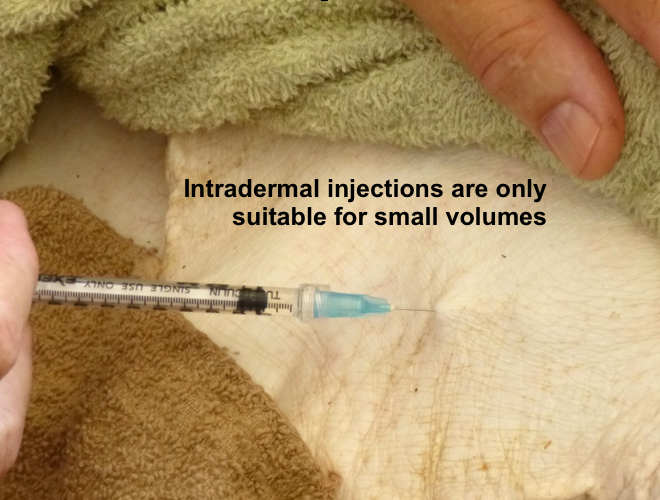
Intradermal injections were only suitable for larger turtles and small volumes. Since we wanted a location where prostaglandins would be absorbed slowly we needed an injection site where we could give a subcutaneous injection that was safe for the turtle and the operator.
To find a suitable site we did a dissection of a RES that had died after a prolonged illness. We selected a location near the base of the tail which you can see in the illustration below. It is labeled “empty space.”
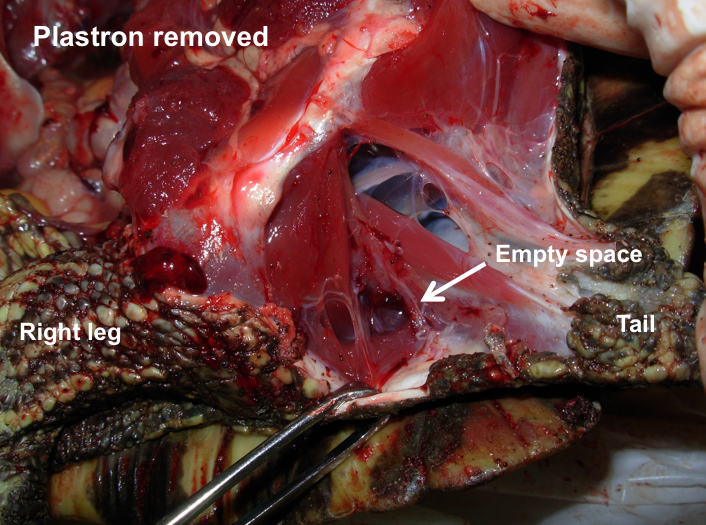
The injection site is labeled “empty space” but, in a healthy turtle, that space would be filled with fat. The next two illustrations show the actual injection technique we used.
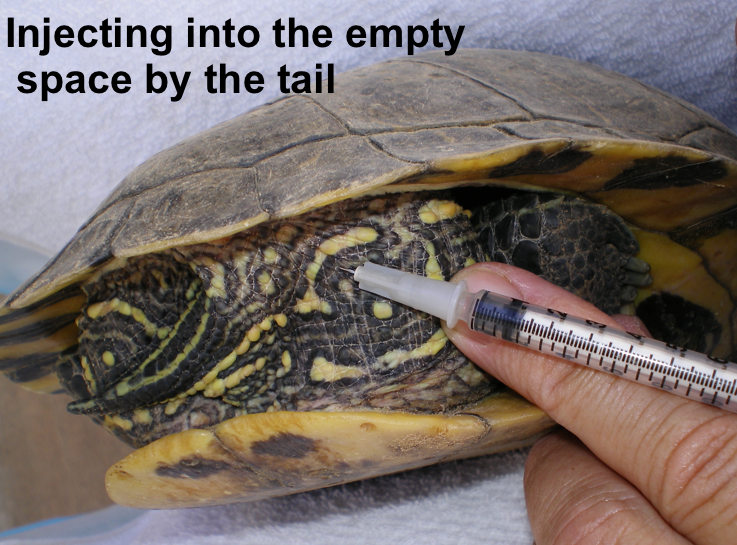

If we wrapped the turtle in a towel, sat down, and held the turtle upside down between our knees, one person could do the injection with no help. As you can see from the table below, an oxytocin injection was slightly more effective at a subq injection site than an intraperitoneal one, and much easier to administer.
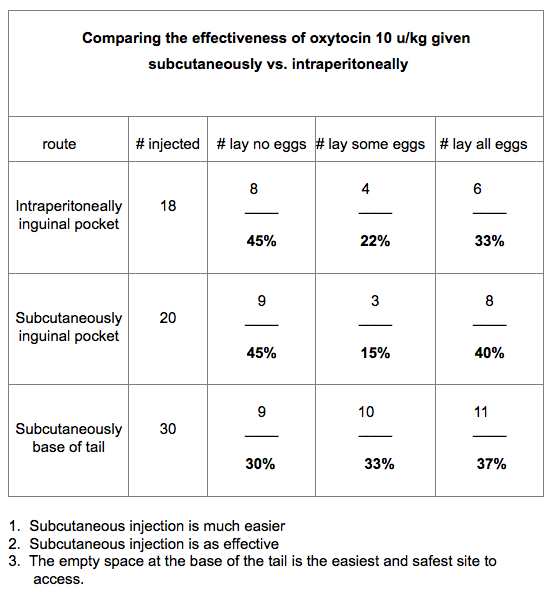
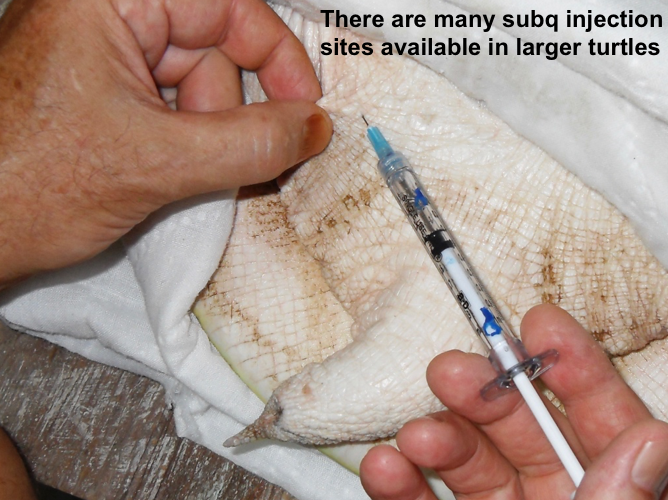
As you can see below, there are a wide variety of subq injection sites available, especially in larger turtles, but the site just superior and lateral to the base of the tail was easy and safe for us and the smaller turtles like red eared sliders.
One other site we experimented with a few years later was near the anterior shoulder muscles as shown below.

Theoretically it is better to give a turtle an injection into the anterior portion of the body because the posterior portion drains directly into the kidneys so the drug is excreted more quickly. In reality an injection into the shoulder exposed the operator to being bitten and required two people to administer because one person had to block the head with a stiff card to prevent the operator from being bitten while the turtle struggles vigorously. As you can see from the table below, the anterior injection site was about as effective as the subcutaneous injection site by the tail but the subcutaneous injection site was much easier to use even if a slightly larger dose had to be administered. The portion of the study dealing with anterior injections suffers from low numbers precisely because the technique was difficult to do safely so we chose not to pursue it further.
