
Early work with various drugs and drug combinations
The tables below show how poor the results were using oxytocin alone (Remember that “success” for us means that the turtle laid all its eggs after one injection). We pooled the intraperitoneal and subq results in the first table because they were similar and very different from the results with PGF-2 as the tables later in this section show. More details on the effectiveness of PGF-2 are highlighted in section nine, “Discovering the importance of PGF-2.”
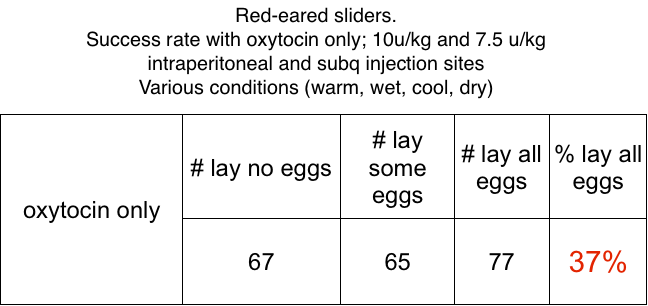
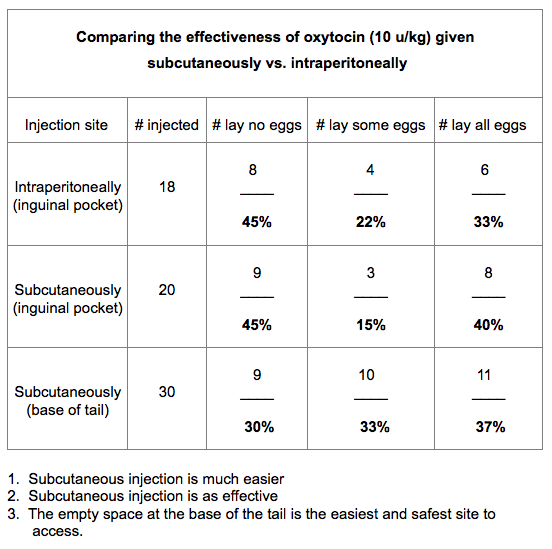
Because of these poor results with oxytocin, a success rate of better than 40% became our target when we experimented with other agents.
The table below shows a number of other agents that we had no success with on their own. These injections were given subq by the base of the tail. We used normal saline as a control and, of course, it had no effect.

One striking failure was arachidonic acid, the precursor to the prostaglandins. It is known to induce oviposition in birds (Wechsung and Houvenaghel 1981), and lizards (Guillette et al.1992). We tested a wide range of doses. Since arachidonic acid is the precursor for many prostaglandins we thought it might be rapidly metabolized to the prostaglandins involved in oviposition. Unfortunately we were wrong; it had no effect.
A gel made with misoprostol (prostaglandin E1) by crushing Cytotec tablets and suspending it in a gel was introduced into the cloaca with a 20 ml syringe and soft plastic tube. This is similar to the technique used to induce childbirth in humans where the gel is applied intravaginally (Frank and Huffaker 1995). However the turtles resented the method and spread the gel all around the lab as they expelled it, rendering it dangerous to us because prostaglandins are readily absorbed through the skin and mucous membranes of humans so they need to be handled with care. The three turtles we managed to load with the gel failed to respond.
Anxiety inhibits childbirth in humans and egg laying in turtles. Propranolol, a beta-blocker used to reduce the peripheral manifestations of anxiety, did not induce egg laying on its own but seemed to have a minimal effect when combined with oxytocin and given by intraperitoneal injection as you can see in the table below.
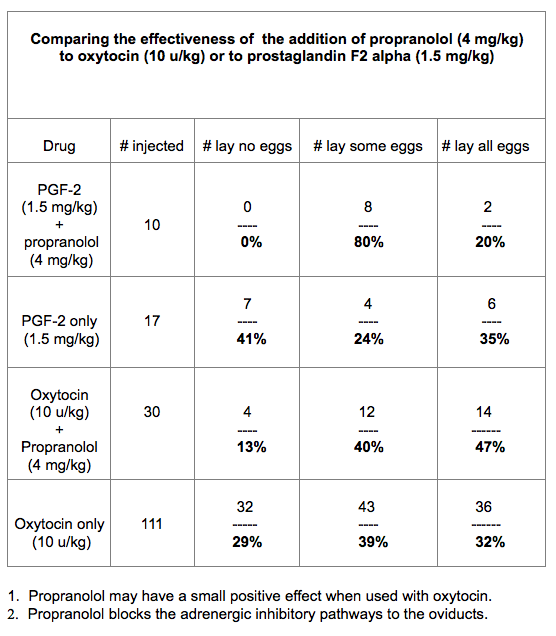
In later experiments with spiny softshell turtles (Apolone spinifera) propranolol seemed to have a positive effect when combined with another agent. You can see this data in the chapter of the “Primary data” in section 15, titled “The drugs we tested on spiny softshell turtles (SSS).”
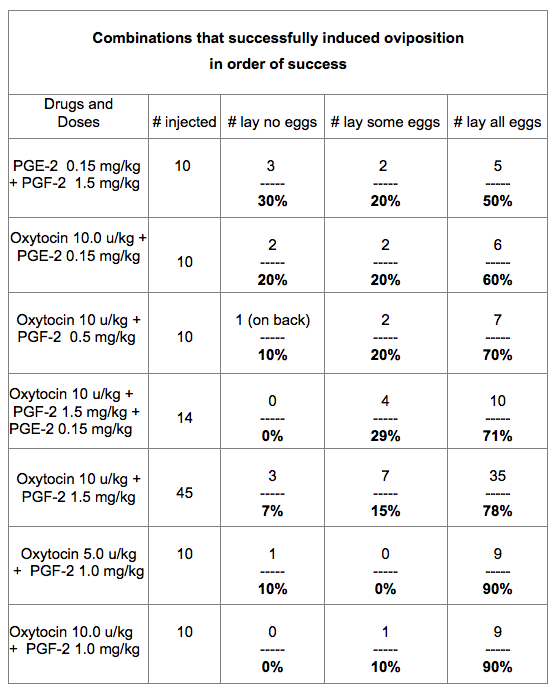
Surprisingly, prostaglandin E2 (PGE-2), an agent known to be involved in oviposition in sea turtles (Guillette et al. 1991a), also proved ineffective on its own. As shown below it also did not enhance other agents (administered at the base of the tail) very much, was expensive to purchase, and time consuming to prepare, so we stopped experimenting with it.
Early on, while we were still using intraperitoneal injections, we decided to experiment with Lutalyse (PGF-2). This is an agent that has been found to be critical in the cascade of events leading to childbirth in humans and egg laying in birds (see the “2007 article” on this web-site for details). We had high hopes that it would prove effective. As you can see in the table below, it didn’t seem to be the case. Lutalyse seemed to be no more effective than oxytocin. This was a big mistake! We had administered the Lutalyse into the peritoneum which had a huge surface area. This caused the agent to be metabolized so quickly that it did not reach adequate blood levels to have an effect.

We then made the mistake of assuming that Lutalyse was not an effective agent on its own and began to experiment with a variety of agents combined with oxytocin. From that point on all injections were given by the subq route at the base of the tail. The table below shows our results.
The dramatic improvement in success when we combined oxytocin and Lutalyse (PGF-2) led us down a primrose path that consumed several seasons of work as we tried to determine the most effective doses and sequences of injection for those combined agents. In fact, the success rate increased because of the subq injection technique, not the drug combination. It took several seasons to realize that Lutalyse alone was more effective than when it was combined with oxytocin! There will be more information on this in section nine, “Discovering the importance of prostaglandin F-2 alpha.”