Working with the Australian snake neck turtle
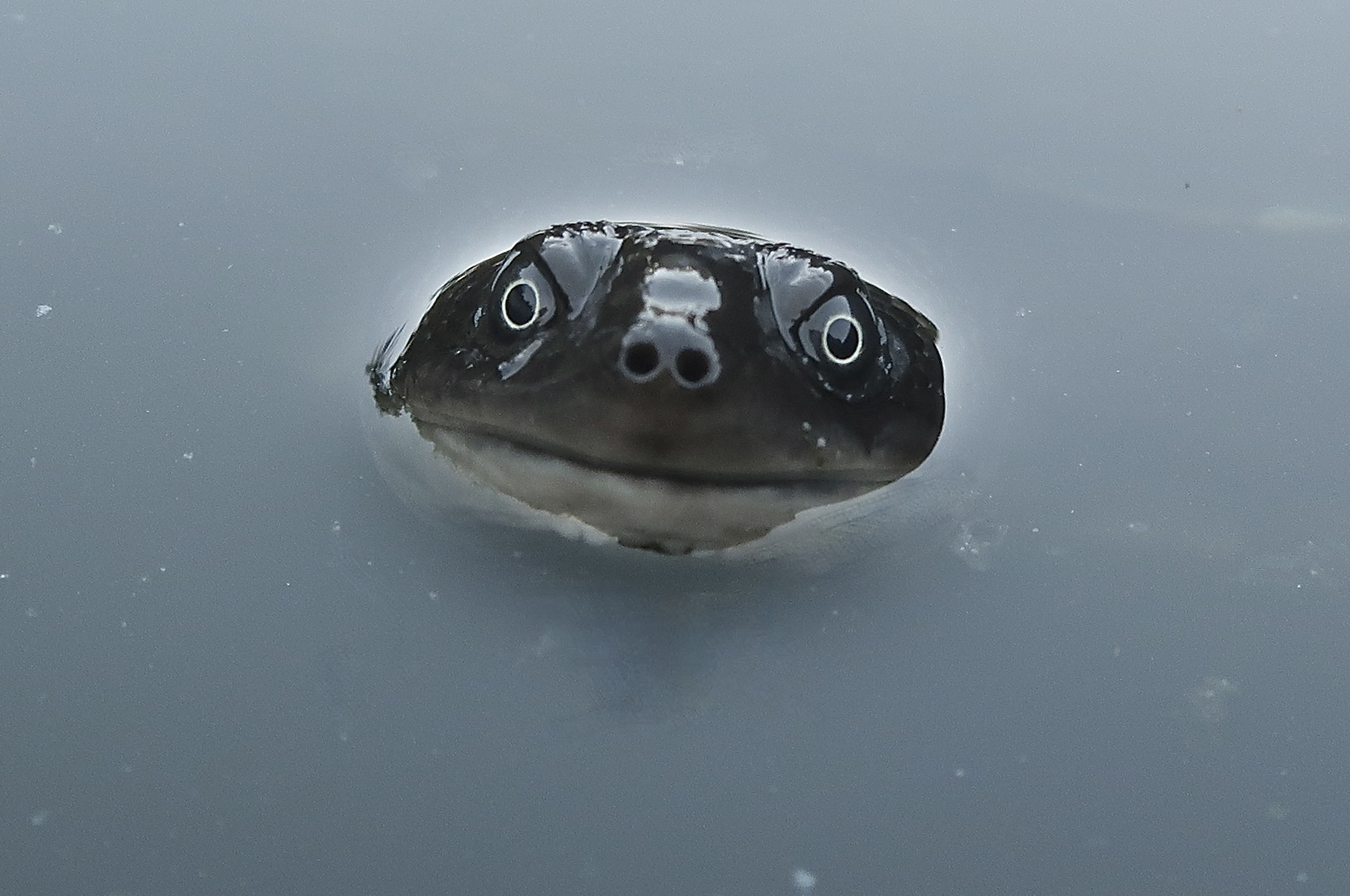
The Eastern snake neck turtle is very different from any of the North American turtles we have worked with. It is an exclusive carnivore with forward facing eyes. It has a very long neck and a narrow head so it can seek out food in hard to reach places.

Like many North American species, snake necks are capable of laying two, or even three clutches a year. The big difference is a result of the Australian climate. In many areas prolonged droughts are common. Though the adults are resistant to dehydration, nest building becomes difficult in dry soils so these turtles have evolved to be able to hold their eggs for long periods while still maintaining the egg’s fertility. So there must be some biochemical mechanism to maintain the oviducts in a quiescent state until the rains arrive. However, there are limits to this egg holding capability since we found the eggs were no longer viable after being held for over two months in one case.
The unique challenges:
There was no turtle farm that was breeding snake necks where we could duplicate the availability of gravid females like there was at the Concordia Turtle Farm in Louisiana. However, there was a population of adult snake necks in the pet community in New Zealand, where we live. We arranged to borrow five adult females for six seasons and an additional four for two seasons.
That meant that, in the best years, we had nine females to induce. Over the total of six years seven females double clutched but there were four seasons where one of the females laid no eggs at all (the females that did not carry eggs in any one year varied). There were also two instances where we failed to detect a pregnant female. This meant we had a grand total of 38 clutches to work with over six years. At Concordia we had 25 clutches a day available to induce. This drastic limitation meant there was no possibility of doing the controlled comparisons we had done with red-eared sliders and softshells in Louisiana. Our only option was to try a “hit and miss” approach; hoping that we’d stumble on one method that would prove reliable.
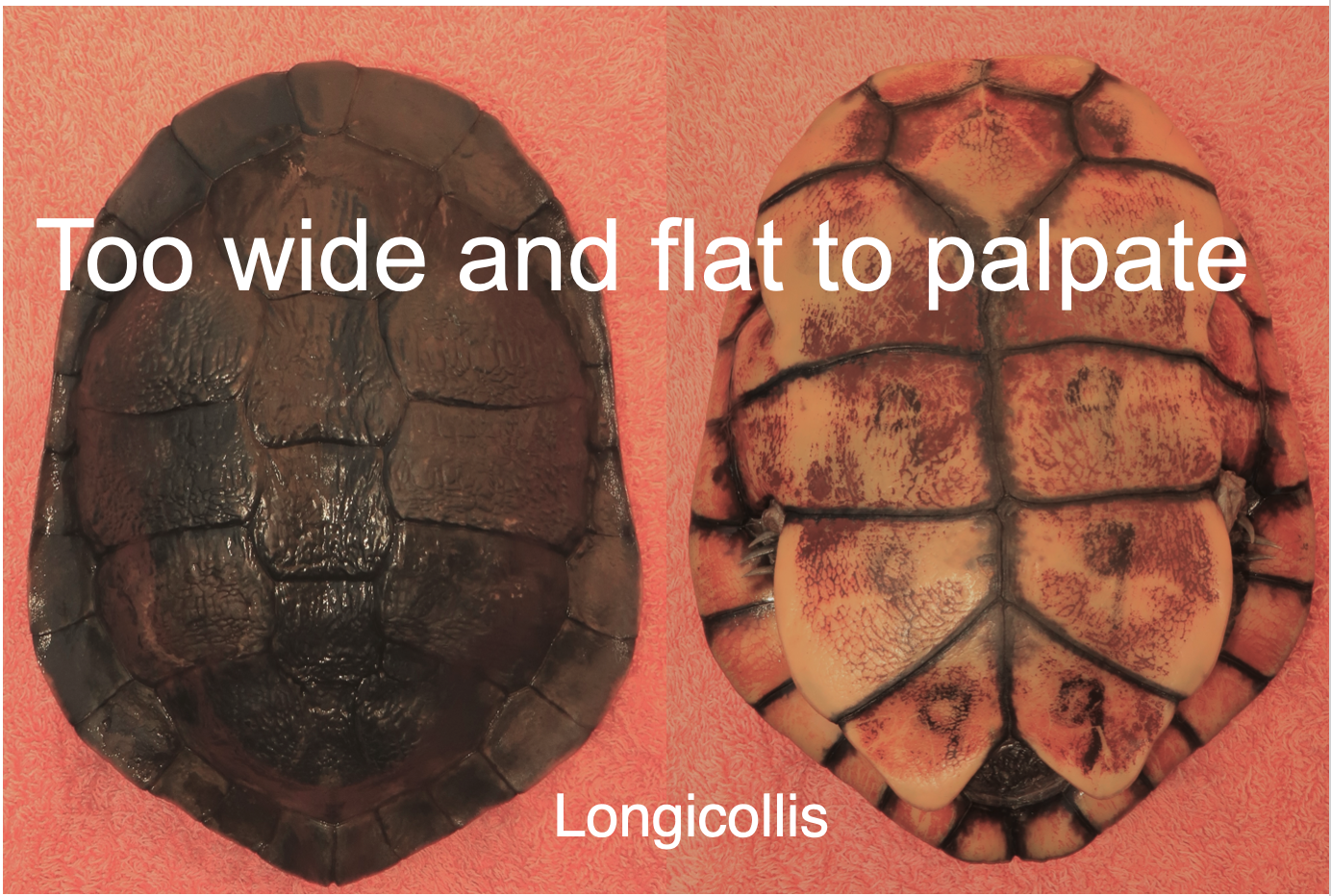
The next problem we faced was detecting which turtles were gravid. Snake necks were too wide and flat to be able to palpate as easily as red eared sliders.
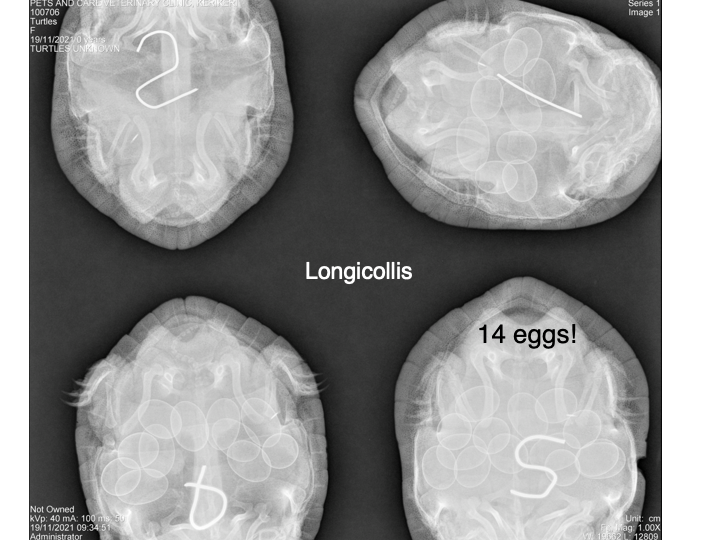
So, we resorted to using x-rays. Since we no longer had an x-ray machine we had to rely on annual visits to the local veterinarian to get the x-rays done, hoping that our timing was right to take the pictures during the gravid state.
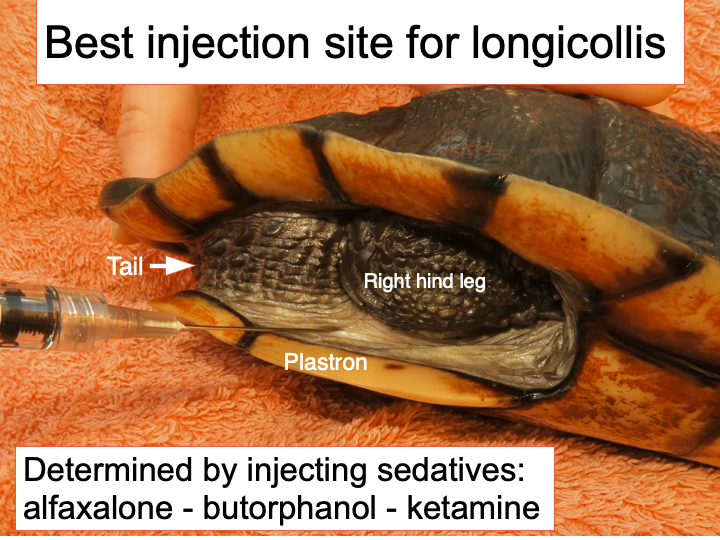
The next issue was where to inject the drugs to induce egg laying. Because the shell structure was so flat we were not able to use the same injection site at the base of the tail as we did with red eared sliders.
After experimentation we came up with the site in the photo below. We determined this by injecting standardised doses of various sedatives and observing their effect. The site that yielded the most significant effect was the one we chose.
The drugs we chose and the results:
We experimented with all the same drugs that we used with American turtles plus we added Alizen (aglepristone) in three cases. Alizen is a progesterone blocker. In many species progesterone is responsible for maintaining a quiescent oviduct or uterus; thus maintaining the pregnant state. We speculated that elevated progesterone levels were responsible for the ability of snake neck turtles to retain viable eggs during prolonged droughts. We reasoned that blocking the progesterone effect would facilitate the induction process. The Alizen was administered in two 10.0 mg/kg doses on successive days and then the turtle was induced on the fourth day. We were unable to detect any conclusive positive effect.
We also tried using some sedatives to reduce anxiety; theoretically improving the chances of a successful induction. This approach had failed with red eared sliders where we experimented with Telazol (see section eight) and found it actually interfered with egg laying.
The agents trialled with snake necks included alfaxalone, ketamine and butorphanol. We only trialled butorphanol once at a low dose of 1.0 mg/kg. There was no observable sedation. We trialled alfaxalone and ketamine in various doses in the two males we had and then used those results to gauge the best doses to trial in the females. Alfaxalone at doses of 20 mg/kg, 12 mg/kg, and even 8 mg/kg proved too large, causing the animals to be deeply unconscious and insensitive to stimulation for 1-2 hours. A dose of 6 mg/kg produced a similar result but only for a half hour. It was almost an “all or nothing” response with dosage differences only determining how long the sedation persisted.
We had previous experience with ketamine at doses as high as 35 mg/kg, which had proved excessive. With five of the snake necks we tried doses of 4-5 mg/kg combined with Dexdomitor 35.0 mcg/kg. There was considerable variation in the response. The drugs appeared to potentiate each other producing an unresponsive state that varied from two to six hours.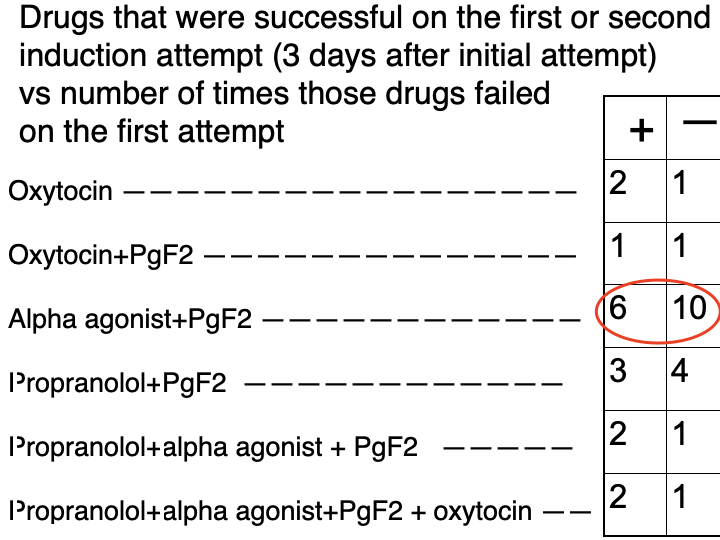
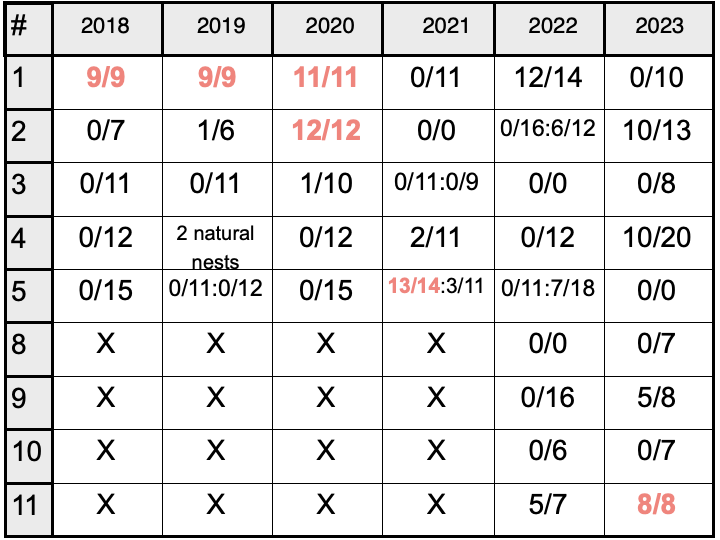
The table below summarises our results using a variety of agents. There were five females induced over six years and two females induced over two years. The first number represents the number of eggs laid. The number after the forward slash represents the total number of eggs in the clutch. Some turtles double clutched in a given year like #2 in 2022 and #3 in 2021. Cases where the female laid all the eggs in the clutch are in red. Note there are only six cases where the turtle laid the entire clutch and three of those were in female #1!
A summary of our experience with
snake-neck turtles:
There are two main problems with this area of our research:
- Numbers: With so few gravid females available to work with it was impossible to do a methodical comparison between different regimens.
2. We had to rely on speculation. We had to just try as many
optional regimens as possible and hope one worked. If an option worked we would try that option on some other gravid females. But, as shown in the table above, we could not find any consistent success
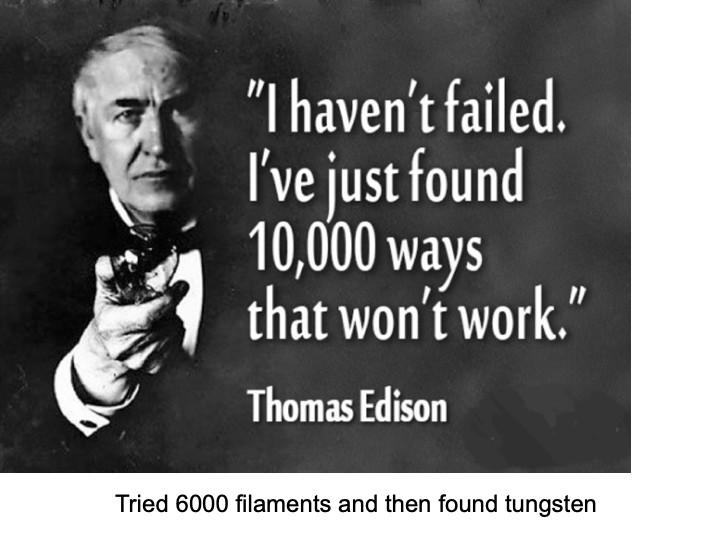
To put it another way:
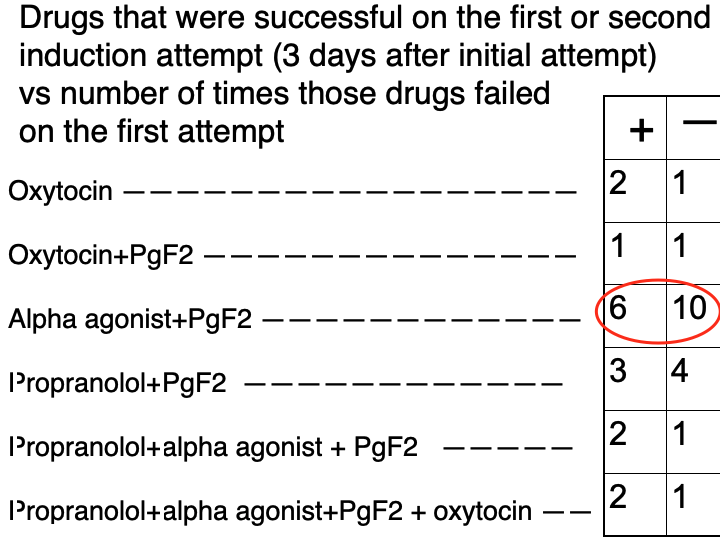
The next chart highlights the inductions that were successful on the first OR the second attempt. Where you see the term “alpha-agonist” it could be Sedivet, xylazine or Dexdomitor.
The largest category here is “Alpha-agonist+PgF2.” This is the combination that proved most effective for North American soft shells and snapping turtles. With Australian snake necks it was successful six times but failed ten times!
Notable failures also include ketamine + alpha agonist + oxytocin and ketamine + alpha agonist + PgF2.